For years I was waiting for my external reality to change before I became who I was meant to be. Then I realized I had the question backwards.
For a long time, I thought my circumstances were the problem. What I did not yet understand was that circumstances were never the issue – my internal operating system was.
I thought I was in the wrong institutions, surrounded by the wrong crowd, earning too little and travelling too little compared to the life I had created in my own mind. I kept thinking about where I should be – in major government institutions, in boardrooms, at international organizations. The more I rehearsed the life I was not living, the more unlivable the life I actually had became. Then suddenly, life became unbearable.
The story I kept rehearsing
What I did not understand at the time was that I was doing something far more consequential than complaining. Every time I told myself this is not enough, I should be further, I should be somewhere else – I was not just venting. I was building a system. Over time, that system strengthened a perception filter that interpreted every experience the same way: wrong place, wrong time, wrong life. Eventually, every experience became evidence that my life was wrong. That interpretation shaped everything I did inside it.
Work became something to endure. Research became an obstacle between me and the life I actually wanted. Every new idea emerged carrying a quiet question I hadn’t consciously decided to ask: Will this even work? Creativity dried up – not because I had lost the ability, but because I had built a system in which I did not trust myself to create.
Then something shifted. I remembered something I had been saying through TEM for years:
The internal operating system shapes the outcomes of the system.
I had been applying that principle to organizations, institutions, and human behaviour at scale. Yet I had never properly applied it to myself.
The question I had been avoiding
I had been asking: what reality am I in? The more powerful question instead is: What operating system am I running inside this reality?
The same person can enter the same environment and produce completely different outcomes depending on their internal operating system. The job remains the same. The institution does not change. Money stays exactly where it was. Yet when interpretation changes, everything that follows changes with it. That new interpretation reshapes identity, which influences behaviour. Behaviour, in turn, determines the outputs that emerge.
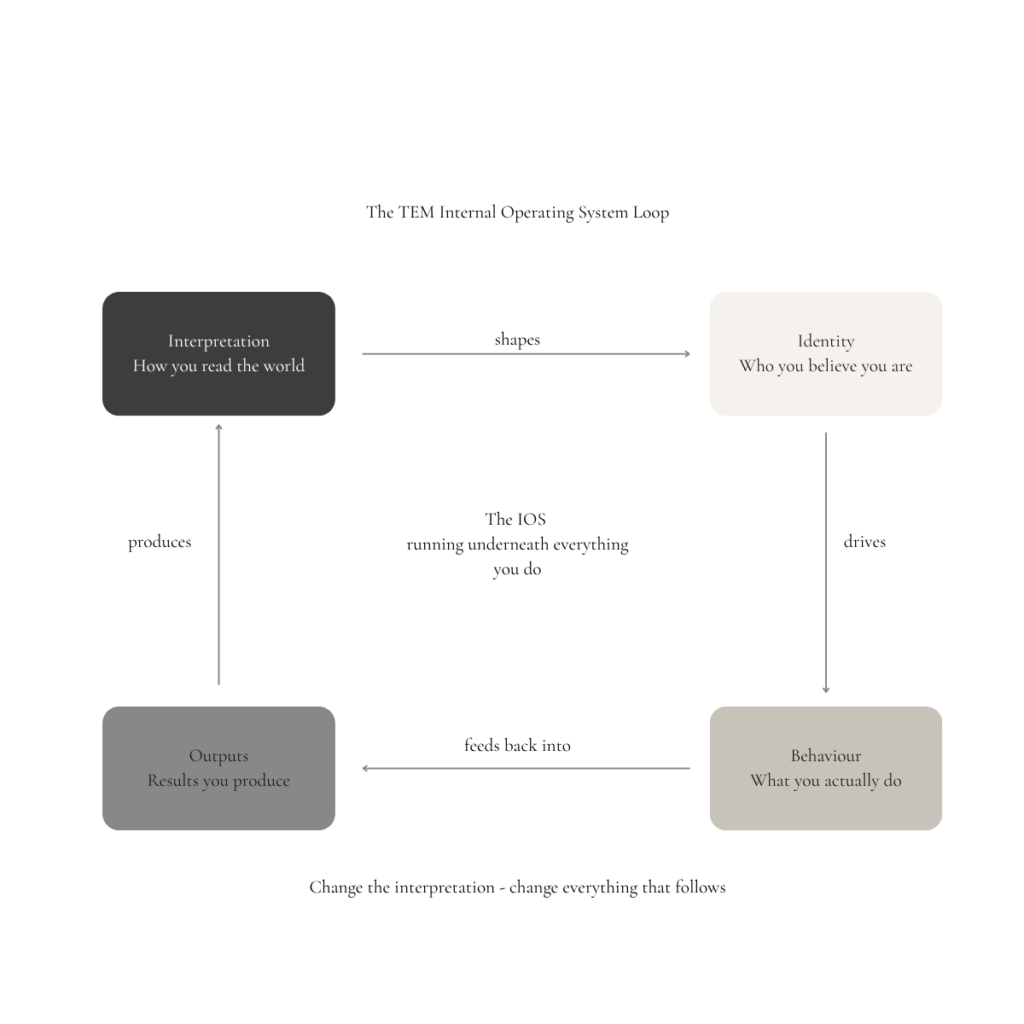
The question that changed everything
For years, I unconsciously asked the same question of every experience: Why am I here instead of somewhere else? The breakthrough came when I replaced that question with a different one: What is this environment asking me to develop?
Once I changed the question, the same circumstances produced different meaning.
If I am working inside an institution, then this is where I develop the ability to lead with integrity – not one day, but now, inside the difficulty. If I am managing limited financial resources, then this is where I learn what I actually need to know about money before I manage more of it. You cannot be trusted with millions if you cannot be trusted with small numbers.
If I am working through hard circumstances, then this is where I find out whether I actually am who I say I am. Do I do what I said I would when the conditions change? Can I operate with the same standards when nobody is watching?
These are not abstract questions. They are the actual conditions through which identity is built – or exposed as performance.
The distinction I had missed
I had been waiting to perform the activities of a founder who solves billion-dollar problems. What I needed to do was embody the operating system of that founder, wherever I am. That is the distinction I had missed entirely.
The founder is revealed by her internal operating system, not by her title. She is revealed by the system she consistently operates from.
The researcher, the diagnostician, the founder. The woman with money, and the woman without it. The woman in a boardroom, and the woman sitting alone trying to understand her life.
The environment changes. The operating system does not.
TEM exists on the premise that internal operating systems shape outcomes across scales – in organizations, in institutions, in economies, and in individuals. The same principle applies to me, which means I was always the first place to look. I am the first TEM case study. And perhaps that was always the work underneath the work.
This does not mean staying forever
Not escaping my current reality as fast as possible. Not reading every difficult circumstance as evidence that I am on the wrong path. But learning to ask, in each moment: What does the TEM CEO do here?
The answer is not always to leave. Sometimes the answer is to learn what this season is uniquely positioned to teach. Other times it means building what only this context makes possible. Often it means setting a boundary, finishing the paper, or stopping long enough to look carefully at what the environment is actually asking. Because if everything is working towards my highest good, then my current reality is not separate from that process. In fact, it is an essential part of it.
This does not mean staying where you are forever. It means you do not have to hate where you are in order to become who you are becoming. You can start now. With what you have. Where you are. The environment you are in is not a waiting room for your real life.
It is the training ground for the identity you are claiming.
Changing the interpretation changes the operating system and the outputs. The map was never wrong. I had simply been holding it upside down.
If you recognized yourself in any part of this – the waiting, the wrong-life feeling, the creativity that dried up – that recognition is the beginning. The system producing that feeling is visible now. And what’s visible can be changed.
“Give me 30 minutes and I’ll show you the exact internal loop producing your results – the one you can’t see because you’re inside it.” Book a session →